Research Reports

Subodha LMS

 India hosts a significant portion of the global visually impaired population, constituting one-third of the 2.2 billion affected individuals (Hindustan Times, 2017). In India, there are about 400+ special schools dedicated to the visually impaired students employing 2000 teachers, of whom 60% are persons with visual impairment. (Vikaspedia, 2020) Even among the school going VI children, many do not study science and mathematics beyond the seventh grade. The current STEM pedagogy is highly visual, making it inaccessible for students with visual impairment. (Parthasarathy, Dey, Gupta 2021). 

To make the curricular content accessible for the VI population and also enable and empower the teachers who play a pivotal role for creating an inclusive learning environment with well-designed pedagogical materials, Learning Management Systems are a necessity. With the introduction of screen readers, VI individuals can now navigate web and mobile applications. Furthermore, the World Wide Web (WWW) Consortium has proposed Web Content Accessibility Guidelines (WCAG) to design software products like NVDA and JAWS. Tying these needs, an accessible Learning Management System was envisioned by Vision Empower (VE), a non-profit organization. This NGO has been successful in addressing institutional voids in the education sector (Parthasarathy, Dey, Gupta 2021). One of their prominent solutions is the accessible Learning Management System (LMS) called Subodha. 

Subodha LMS was created using the Open EdX platform for sharing inclusive and accessible content and pedagogical approaches. It is used for the dissemination of accessible STEM content for K-10 created by the team. 
Click to download the PDF of “Subodha LMS”

IRIS: Encouraging self-learning of tactiles among blind and visually impaired students

Abstract Brief:

Blind and visually impaired students across India face challenges learning complex scientific diagrams. While teacher assistance is essential, the high student-teacher ratio makes it difficult to provide an engaging learning experience at scale. In this pilot study, we introduce IRIS, a novel TV remote-sized product designed for visually impaired children to explain the tactiles in audio format. Results show that IRIS helped students learn about scientific processes in regional languages and provided for a more comprehensive, holistic grasp of the concepts presented in the tactile diagram when compared to other methods. We propose IRIS as an assistive technology geared to make students self-reliant in learning tactiles with minimum assistance from teachers, thereby reducing their workload.

Click to download the PDF of “IRIS: Encouraging self-learning of tactiles among blind and visually impaired students”.

Landscape mapping of the disability sector in India

Stakeholder perspective and recommendations for action

November 2024, India

Report prepared by: Neha Trivedi, Spandan, Inclusion and Accessibility Consultancy; Lakshmi Narasimhan, TSI Consulting, LLP

Published by: Vision Empower

This report seeks to summarise the landscape of unmet needs and challenges and present recommendations for way forward for the sector of visual disability in India

Click to view PDF

Image showing the first Title and abstract of the paper "Landscape mapping of the disability sector in India". Click to download the PDF

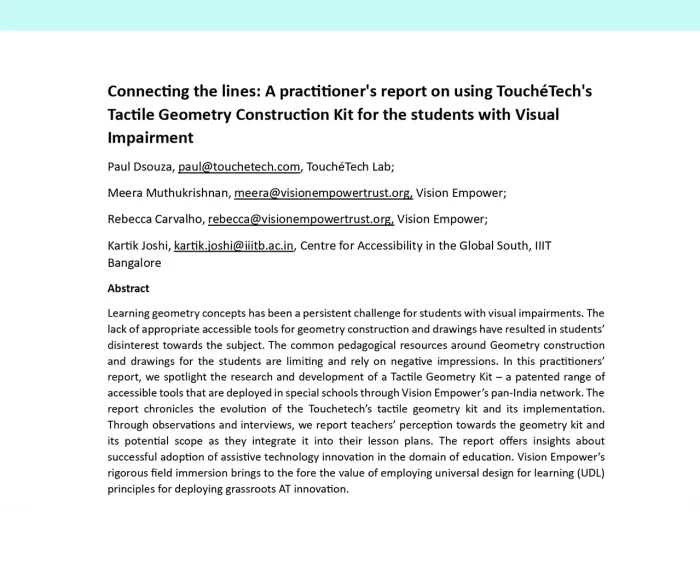
Connecting the lines: A practitioner’s report on using TouchéTech’sTactile Geometry Construction Kit for the students with VisualImpairment

Authors: Paul Dsouza, TouchéTech Lab; Meera Muthukrishnan, Vision Empower; Rebecca Carvalho, Vision Empower; Kartik Joshi, Centre for Accessibility in the Global South, IIIT Bangalore

Abstract

Learning geometry concepts has been a persistent challenge for students with visual impairments. The
lack of appropriate accessible tools for geometry construction and drawings have resulted in students’
disinterest towards the subject. The common pedagogical resources around Geometry construction
and drawings for the students are limiting and rely on negative impressions. In this practitioners’
report, we spotlight the research and development of a Tactile Geometry Kit – a patented range of
accessible tools that are deployed in special schools through Vision Empower’s pan-India network. The
report chronicles the evolution of the Touchetech’s tactile geometry kit and its implementation.
Through observations and interviews, we report teachers’ perception towards the geometry kit and
its potential scope as they integrate it into their lesson plans. The report offers insights about
successful adoption of assistive technology innovation in the domain of education. Vision Empower’s
rigorous field immersion brings to the fore the value of employing universal design for learning (UDL)
principles for deploying grassroots AT innovation.

Click to download the publication

Image showing the first Title and abstract of the paper "Connecting the lines: A practitioner's report on using TouchéTech'sTactile Geometry Construction Kit for the students with Visual Impairment". Click to download the PDF

Well-being at Vision Empower. Article in WIPRO Newsletter Samuhik Pahal January 2025

Meghna Chowdhury and Supriya Dey write on the theme of Well-being at Vision Empower in the January 2025 issue of Samuhik Pahal, WIPRO’s journal of collective action. At Vision Empower (VE), fostering both individual and collective well-being is at the heart of our organizational approach.

Creating an Accessible Technology Ecosystem for Learning Science and Math: A Case of Visually Impaired Children in Indian Schools

Creating an Accessible Technology Ecosystem for Learning Science and Math: A Case of Visually Impaired Children in
Indian Schools
View PDF

Learning through Play, Designing a Game-Based Curriculum to Teach Numeracy Skills

Learning through Play, Designing a Game-Based Curriculum to Teach Numeracy Skills : View PDF