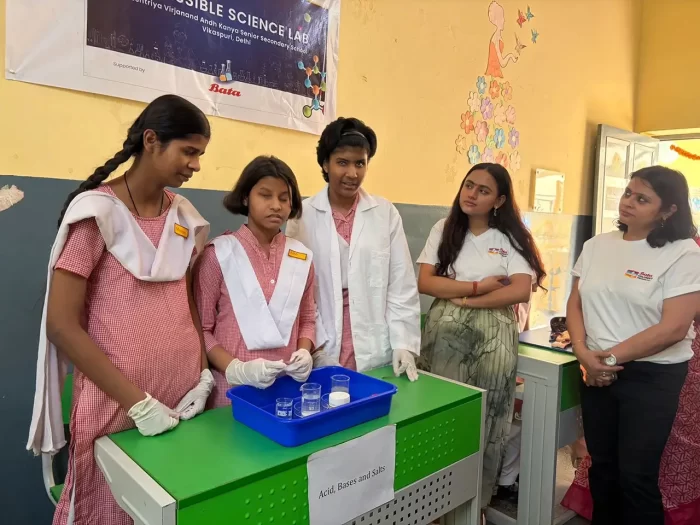
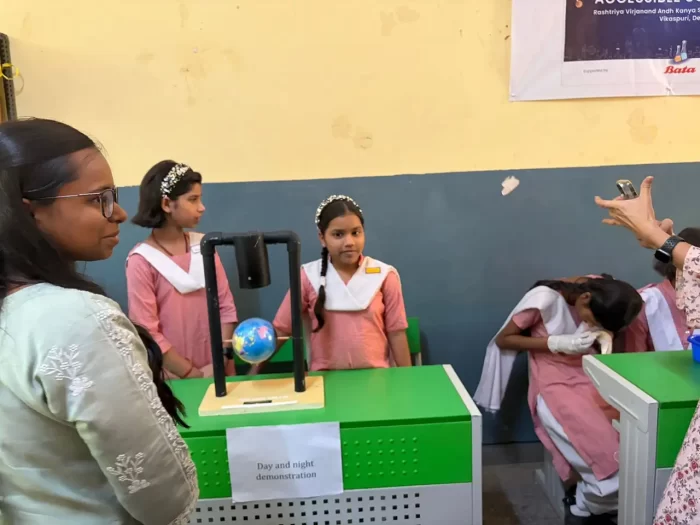
Vision Empower inaugurated an Accessible Science Lab at Rashtriya Virjanand Andh Kanya Senior Secondary School, Vikaspuri, Delhi established in partnership with Bata India Limited.
Created with the vision of making STEM learning inclusive and engaging, the lab enables students with visual impairment to explore Science and Math through tactile models, adapted experiment kits, and hands-on learning tools designed for accessibility.
The inauguration was attended by representatives from Bata India, including KAVITA KHURANA (CSR Lead & Assistant Vice President HR), Om Raghav (CSR & Facility Manager), and Kajal Chauhan (CSR Coordinator). Officials from the Department of Empowerment of Persons with Disabilities, along with the school leadership -Secretary Hemlata, Manager Tripta Choudhary, and Head of School Pratibha Shrivastava were also present at the event.
The intervention currently reaches 29 students, but its impact goes far beyond access to tools and academic learning. The lab is helping nurture confidence, independence, communication, and active participation, empowering students to engage with STEM education in meaningful and self-assured ways.
This video captures those moments of independence, confidence, and children owning their learning.
Accessible Science labs for visually impaired children enable hands-on, inclusive learning by using tactile models and adapted tools to make science and math understandable. These labs help children actively explore concepts, build confidence, and develop independence—transforming how they learn and engage with STEM subjects.
What Are Accessible Science Labs?
Accessible Science labs are specially designed learning environments that make Science, Technology, Engineering, and Mathematics (STEM) inclusive for children who are visually impaired.
At Vision Empower, these labs are built to bridge the gap between ability and opportunity, ensuring that every child can:
- Experience concepts directly
- Engage actively in learning
- Participate equally in classroom activities
Rather than adapting children to the system, these labs adapt the system to the child.
How Accessible Science Labs Transform Learning
From Abstract to Tangible Understanding
STEM subjects often rely heavily on visual teaching methods. Accessible Science labs change this by introducing:
- Tactile models to represent diagrams and structures
- Adapted experiment kits for hands-on exploration
- Audio-supported learning tools for better comprehension
This approach allows children to feel, explore, and understand concepts that would otherwise remain abstract.
Learning Through Experience, Not Just Theory
Traditional learning often focuses on memorization. In contrast, accessible STEM labs emphasize:
- Experimentation
- Observation
- Exploration
Children are encouraged to:
- Ask questions
- Test ideas
- Learn through discovery
This makes learning more meaningful and long-lasting.
Beyond Accessibility: Building Confidence and Independence
Accessible STEM labs do more than provide educational access—they create transformation.
Key Outcomes Observed
- Increased confidence in expressing ideas
- Greater independence in learning tasks
- Improved communication and collaboration skills
- Stronger problem-solving abilities
As children engage with experiments, they begin to take ownership of their learning. This shift is visible not just academically, but socially and emotionally as well.
Why Inclusive STEM Education Matters Today
In today’s world, STEM skills are critical for future opportunities. However, children with visual impairments are often excluded due to lack of accessible resources.
Accessible STEM labs help:
- Promote equity in education
- Open pathways to STEM careers
- Encourage inclusive classrooms
By making STEM accessible early, we ensure that no child is limited by how they learn.
The Vision Empower Approach
At Vision Empower, accessible STEM labs are designed with a clear purpose:
- To make learning interactive and inclusive
- To focus on ability rather than limitation
- To create environments where children can explore without barriers
The goal is not just education—but empowerment.
Key Takeaways
- Accessible STEM labs make science and math hands-on and inclusive
- Tactile and adapted tools help children understand complex concepts
- Learning becomes interactive, engaging, and meaningful
- Students develop confidence, independence, and social skills
- Inclusive STEM education creates long-term opportunities
FAQ: Accessible STEM Labs for Visually Impaired Children
1. What are accessible STEM labs?
They are inclusive learning spaces designed with tactile tools and adapted resources to help visually impaired children learn STEM subjects effectively.
2. How do visually impaired children learn science and math?
Through tactile models, hands-on experiments, and audio-supported tools that make abstract concepts easier to understand.
3. Why are accessible STEM labs important?
They ensure equal learning opportunities, build confidence, and help children develop essential skills for future education and careers.
4. What skills do children gain from these labs?
Children gain problem-solving skills, independence, communication abilities, and confidence in learning.