Why the first six years decide so much for a child who cannot see – and what an inclusive Anganwadi really takes.
By Vidhya Anand
Every newborn who enters this world has a clock that is ticking – and for a child with disability, that clock ticks a little faster. The first six years are when the brain builds its foundations: language, movement, the ability to make sense of the world. Miss that window, and you are not just delaying learning; you are letting a difficulty harden into something far harder to undo.
Government estimates cited at the national level suggest that close to a third of disabilities in the country could be prevented if they were caught early enough – and that with simple, play-based stimulation before the age of six, developmental delays can be stopped before they deepen into more severe disability. So, what causes the delay? Often it is a lack of awareness among caregivers, poor medical facilities in the village, and many other reasons besides.
For a child who cannot see, that window matters even more – because so much of what other children absorb just by looking around them, a blind child will simply miss unless someone deliberately brings the world within reach. The blindness is rarely the real barrier. The barrier is a world that was never made reachable in time.
Why the Anganwadi, and why now
Like any other preschool, the anganwadi is the first place away from home that a child steps into to learn new things. In India, the anganwadi network reaches more than eight crore children from birth to six years – which makes it, for most families, the very first place outside the home where a child’s development is watched by someone trained to watch it. It is often the first point at which a delay, or a visual impairment, could be noticed at all.
The government has now made this explicit. In November 2023, the Ministry of Women and Child Development launched the Anganwadi Protocol for Divyang Children, developed together with the Department of Empowerment of Persons with Disabilities and the Ministry of Health and Family Welfare. It sits within the Poshan Bhi Padhai Bhi programme and lays out a clear, three-step role for the anganwadi worker:
- Screen — track developmental milestones to catch early signs of disability.
- Include — make the centre, its activities and its community genuinely open to children with disabilities, and support their families.
- Refer — connect children showing signs of disability to specialised help, through ASHA (Accredited Social Health Activist) and ANM (Auxiliary nurse midwife) workers and the Rashtriya Bal Swasthya Karyakram (RBSK) teams.
The protocol rests on a wider policy foundation — the National Education Policy 2020‘s preference for integrating children with disabilities into mainstream settings rather than segregated ones, the National Curriculum Framework for the Foundational Stage 2022, and the Rights of Persons with Disabilities Act, 2016. On paper, the architecture is sound. The harder question is what it looks like when the circular reaches the classroom?
What a blind child needs that a syllabus won’t tell you
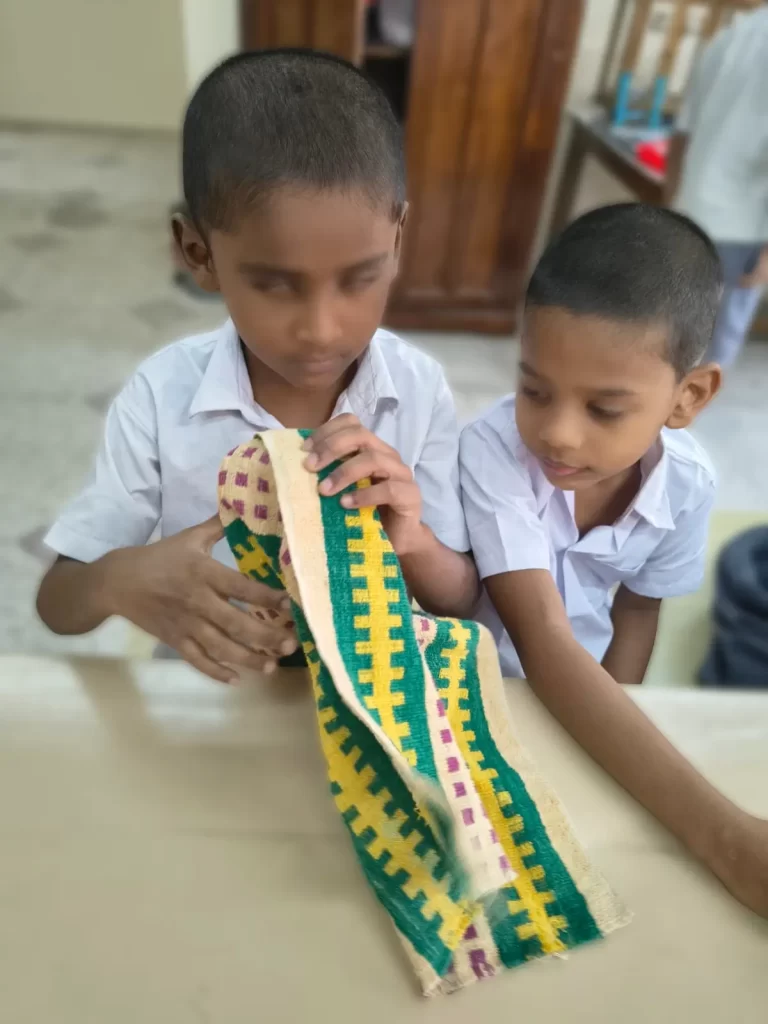
A sighted toddler learns what a cup is by seeing dozens of them. A blind toddler learns it only if someone places a real cup in their hands – lets them feel the handle and rim, hear water poured into it, and hears the word “cup” said at the same moment, again and again. The concept does not arrive on its own. This is why, for a visually impaired child, an inclusive anganwadi is not mainly about equipment. It is about deliberate, patient, sensory teaching of things other children pick up for free.
This changes not only the room but the adults around the child. It is the difference between a centre that has a blind child sitting in the corner and a centre where a blind child is genuinely learning alongside everyone else.
Inclusion is a verb
From the ground, not the guidebook, a few things matter far more than the word “inclusive” suggests.
- A welcoming greeting. Choice-making is a skill children should meet early. Many anganwadis offer three or four ways for a child to be welcomed into class – a fist bump, a high-five, a hug, a little dance. The same choice should be offered to a child with a disability, with the options presented in an accessible way they can feel or hear.
- A space that stays the same. A blind child builds a mental map of a room and moves by memory. An inclusive anganwadi keeps its layout consistent – the same corner for play, the same path to the toilet, furniture that does not wander. Add simple tactile cues (a textured strip, a particular mat) and even rooms can be navigated independently. This costs almost nothing; it costs attention.
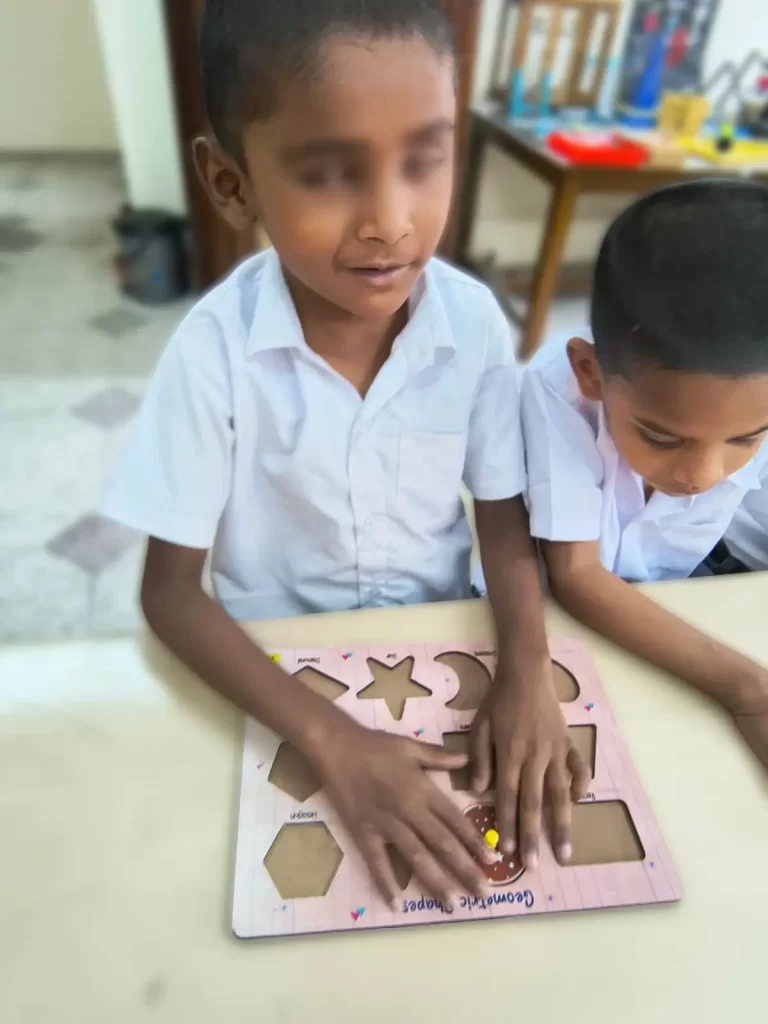
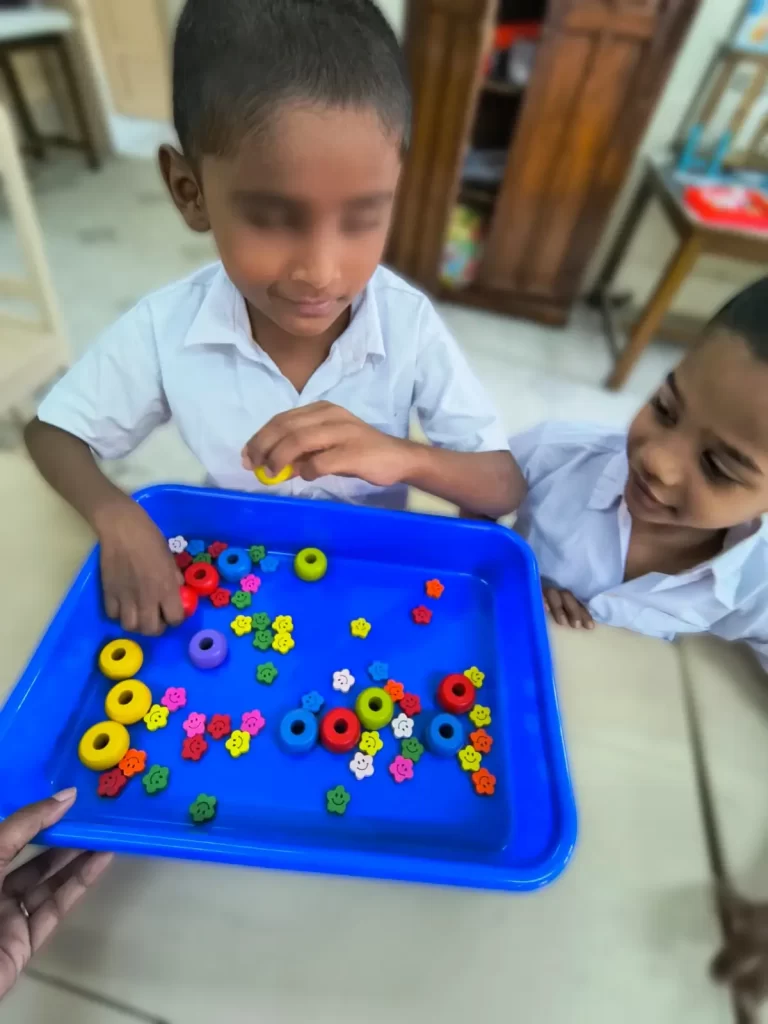
- Materials you can hear and feel, used by everyone. Multisensory, low-cost, locally made materials — textured objects, sound-making toys, real things to handle – are exactly what the protocol’s “multi-sensory, toy-based approach” calls for. The test of inclusion is whether these are used by all the children together, not handed only to the disabled child and put away again. Shared materials make a shared classroom.
- A teacher who narrates the world. The single most powerful tool is the anganwadi teacher’s own practice: naming everything aloud, describing richly what is happening, guiding hand-under-hand rather than doing things for the child, and holding the simple expectation that this child can take part. Children take their cue from that adult; when she treats a disability as ordinary, so does the rest of the room.
- Capacity building that lasts. Training for teachers who support children with special needs should be monitored periodically to ensure it actually works, and recruiting qualified special educators for these settings is essential. Programmes should be designed to create a cascade of mentoring – knowledge and skills passing smoothly from one teacher to the next — so inclusive practice strengthens across the whole system.
- Wall displays that can be read by touch. When displays are adapted for visually impaired children — alphabet charts carrying Braille letters alongside the printed ones – the room itself begins to teach every child.
- Screening folded into the ordinary day. Early identification is not a separate event. It is a teacher who notices that a child is not tracking sound, not reaching, not responding as expected – and knows what to do next. Every anganwadi should be linked with a speech therapist and an occupational/vocational therapist, so they can work as a team across varied disabilities.
- Family carried along. Inclusion that does not reach the family stops at the gate. Run short workshops to show parents the strategies used to teach a concept, so the same can continue at home. Keep parents updated on the milestones their child reaches and the challenges they meet.
Teacher is just not an Implementor
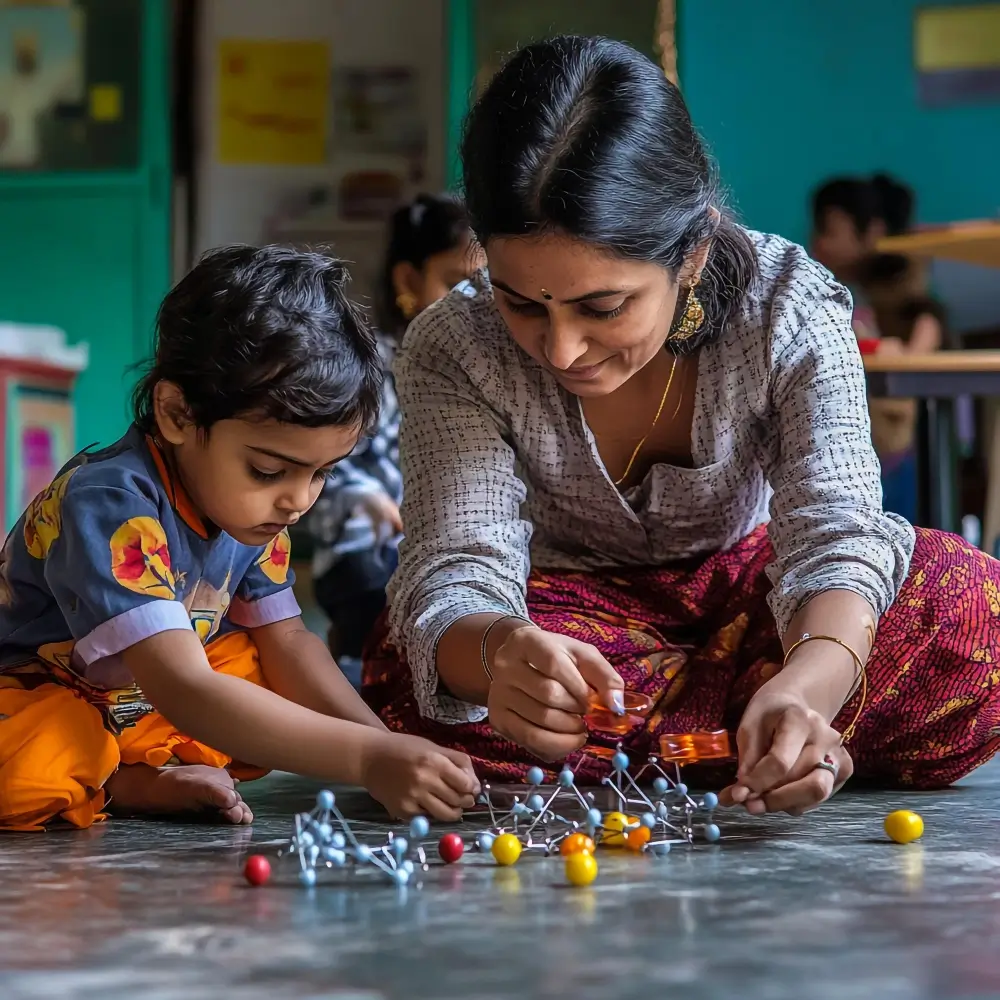
The Teacher has always been seen as the one who executes the lesson plan. To a sighted toddler in preschool the Teachers become her second Mom. But for a blind child that picture leaves out pretty much everything that counts. The lesson plan is the least important thing she does. What she really does is just show up – a stable, consistent, trustworthy presence for the child to orient them to in their unseen world
She is, first, an observer. Because a blind child cannot show you with their eyes what they have understood, the teacher reads it in other ways – a hand that hesitates, a turn toward a sound, a new word used correctly. She often notices a delay, or a hidden strength, before anyone else does, and she knows what to do with what she notices.
She is someone who connects. The relationship comes before the curriculum: a child who feels safe with their teacher will reach, try and risk being wrong. And that connection extends to the family – she listens to parents, learns from them what the child is like at home, and sends learning back the other way, so the two worlds pull together. She adapts in the moment. She follows the child’s readiness rather than the clock, changing the plan on the spot when a child needs a different route in. And she holds a quiet, powerful belief that this child can – because children, and the adults around them, take their cue from how the teacher sees the child.
Finally, she knows she does not have to do it alone. Asking for help – from a therapist, a senior colleague, a specialist — is not a gap in her ability but a mark of good practice, and she stays open to learning, treating her own growth as part of the job. A teacher like this is not implementing a programme. She is the reason it works.
The family is the other classroom
It is tempting to treat parents as occasional helpers. For a child who cannot see, that is backwards. A blind child learns the world mostly through touch, sound and language – and the people who can give that, all day long, in the most ordinary moments, are the family. The parent who says “this is your steel cup, it is cold, listen to the water going in” is teaching language, concepts and confidence in a single sentence that no weekly class session can replace
This becomes important because so many of the early lessons are learned through observation. The sighted toddler learns words, movements and concepts just by observing the adults around him; the blind toddler misses out on this natural learning process unless an adult consciously narrates the environment to them. This is also the reason why certain developmental steps are delayed in blind children – not because of their inability but simply because there is less to learn and less motivation to reach out to an unseen world. This is precisely the role played by the family.
The evidence is striking on one point in particular: with families, earlier is better. Studies of parent-support programmes find that coaching parents of very young children produces stronger gains than the same help offered after the age of five – because the skills parents learn early feed straight into the years when development moves fastest. Empowered, confident parents also tend to stay involved, and that sustained involvement is linked to better language, stronger social-emotional skills and smoother school readiness.
So, an inclusive anganwadi does not just inform parents; it equips them. It shows parents how to build a concept through touch, sends a simple activity home, celebrates the small win the family reports back, and treats the home as a second classroom running every day of the week. When that happens, the few hours at the centre stop being the whole of a child’s learning and become the spark for it.
The gap between the circular and the classroom
It would be dishonest to pretend the policy and the practice are the same thing. The Anganwadi Protocol is genuinely strong, and the government has backed it with funding for training and a commitment to upgrade more than thirteen lakh centres. But a protocol does not, by itself, change a room.
What changes a room is training that actually reaches the teacher, materials that actually arrive, and above all – ongoing support rather than a single workshop. Anyone who has done this work knows the recurring lessons: the need for reinforcement and modification, the challenge of managing a mixed-ability group, the value of a predictable routine that also tends to a child’s mental wellbeing, and how much a teacher relies on continued mentoring rather than a one-time briefing. Self-reflection and honest documentation of what happens in class make that reflection richer and more useful. The policy opens the door; people walk through it – and policy must also ensure effective delivery and periodic follow-up on how capacity building is actually carried out.
What changes when we get it right
When it works, the result is quiet and ordinary – which is exactly the point. A blind four-year-old finds her own way to the play corner. She is handed the same textured blocks as the child beside her. She is spoken to, described to, expected of. She arrives at the threshold of school not behind, but ready – and, just as importantly, she has spent her early years belonging rather than waiting.
Sharing the impact story from the field
From Silence to Confidence
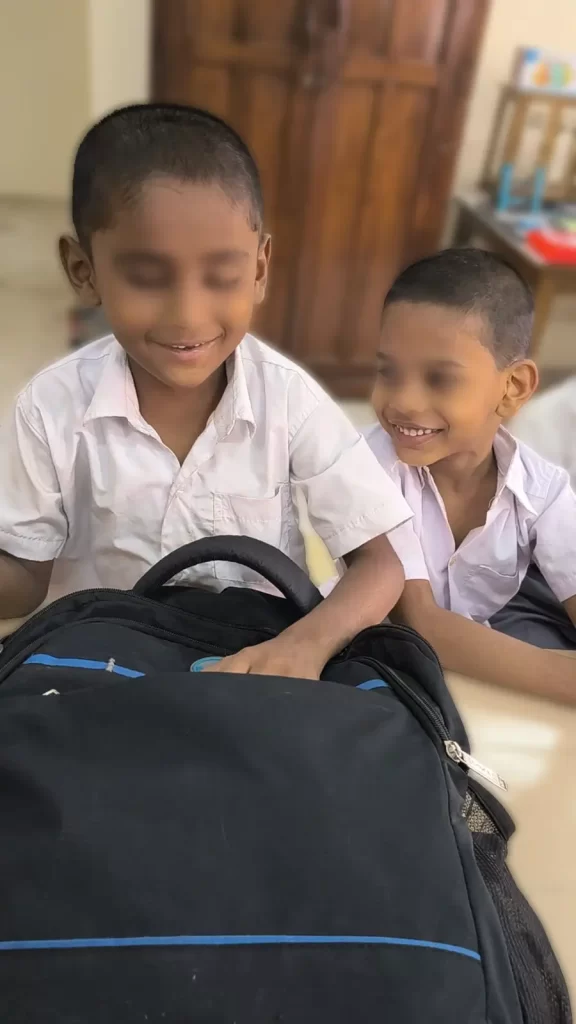
When Samim Molla, a Class 1 student from Ramakrishna Mission Blind Boys’ Academy, Narendrapur, first joined the school, he was very shy and preferred to stay alone. Coming from a disadvantaged background and being fully blind, he rarely spoke and often sat quietly in a corner. Through regular ECCE classes, encouragement from me , and support from his friends, Samim gradually began to gain confidence. The child who once hesitated to speak now actively participates in class, motivates his peers to attend sessions, and even helps explain activities to other students.
His transformation has been truly inspiring. Watching him grow into a confident and supportive learner has been a rewarding experience and a reminder that every child can thrive when given the right guidance, care, and opportunities.
That is what an inclusive anganwadi is for. Not a ramp at the door and a line in a register, but a child who was caught in time, in a room that was made reachable, by Pritikona, school coordinator from Vision Empower, who believed she could. The window does not stay open forever. The remarkable thing is how much we can do while it is.
Sources
- Anganwadi Protocol for Divyang Children, Ministry of Women & Child Development (PIB, Nov 2023).
pib.gov.in/PressReleaseIframePage.aspx?PRID=1980609 - National Education Policy 2020; National Curriculum Framework for the Foundational Stage 2022; Rights of Persons with Disabilities Act, 2016.
- Parenting Interventions That Promote Child Protection and Development for Preschool-Age Children with Developmental Disabilities: A Global Systematic Review and Meta-Analysis – Zuyi Fang, Xinran Liu, Cheng Zhang, Jamie M. Lachman, Dongping Qiao, 2024

Vidhya Anand comes from an education background, with experience working in private schools. A visit to a government school reshaped her understanding of inclusion. It reinforced her belief that children with visual impairments are as capable as their sighted peers; the real barrier is the lack of an accessible environment.
As Programme Manager for Early Childhood Care and Education at Vision Empower, Vidhya works towards making anganwadis more inclusive and accessible, so that children with visual impairments can build strong foundational skills and pursue their dreams.