PUBLICATIONS

Subodha LMS

 India hosts a significant portion of the global visually impaired population, constituting one-third of the 2.2 billion affected individuals (Hindustan Times, 2017). In India, there are about 400+ special schools dedicated to the visually impaired students employing 2000 teachers, of whom 60% are persons with visual impairment. (Vikaspedia, 2020) Even among the school going VI children, many do not study science and mathematics beyond the seventh grade. The current STEM pedagogy is highly visual, making it inaccessible for students with visual impairment. (Parthasarathy, Dey, Gupta 2021). 

To make the curricular content accessible for the VI population and also enable and empower the teachers who play a pivotal role for creating an inclusive learning environment with well-designed pedagogical materials, Learning Management Systems are a necessity. With the introduction of screen readers, VI individuals can now navigate web and mobile applications. Furthermore, the World Wide Web (WWW) Consortium has proposed Web Content Accessibility Guidelines (WCAG) to design software products like NVDA and JAWS. Tying these needs, an accessible Learning Management System was envisioned by Vision Empower (VE), a non-profit organization. This NGO has been successful in addressing institutional voids in the education sector (Parthasarathy, Dey, Gupta 2021). One of their prominent solutions is the accessible Learning Management System (LMS) called Subodha. 

Subodha LMS was created using the Open EdX platform for sharing inclusive and accessible content and pedagogical approaches. It is used for the dissemination of accessible STEM content for K-10 created by the team. 
Click to download the PDF of “Subodha LMS”

IRIS: Encouraging self-learning of tactiles among blind and visually impaired students

Abstract Brief:

Blind and visually impaired students across India face challenges learning complex scientific diagrams. While teacher assistance is essential, the high student-teacher ratio makes it difficult to provide an engaging learning experience at scale. In this pilot study, we introduce IRIS, a novel TV remote-sized product designed for visually impaired children to explain the tactiles in audio format. Results show that IRIS helped students learn about scientific processes in regional languages and provided for a more comprehensive, holistic grasp of the concepts presented in the tactile diagram when compared to other methods. We propose IRIS as an assistive technology geared to make students self-reliant in learning tactiles with minimum assistance from teachers, thereby reducing their workload.

Click to download the PDF of “IRIS: Encouraging self-learning of tactiles among blind and visually impaired students”.

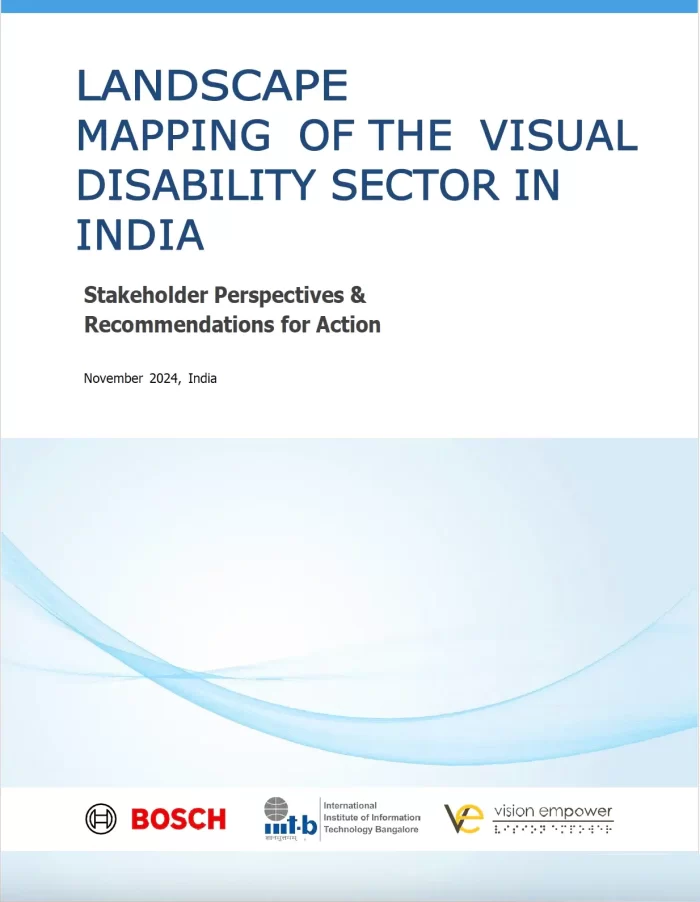
Landscape mapping of the disability sector in India

Stakeholder perspective and recommendations for action

November 2024, India

Report prepared by: Neha Trivedi, Spandan, Inclusion and Accessibility Consultancy; Lakshmi Narasimhan, TSI Consulting, LLP

Published by: Vision Empower

This report seeks to summarise the landscape of unmet needs and challenges and present recommendations for way forward for the sector of visual disability in India

Click to view PDF

Image showing the first Title and abstract of the paper "Landscape mapping of the disability sector in India". Click to download the PDF

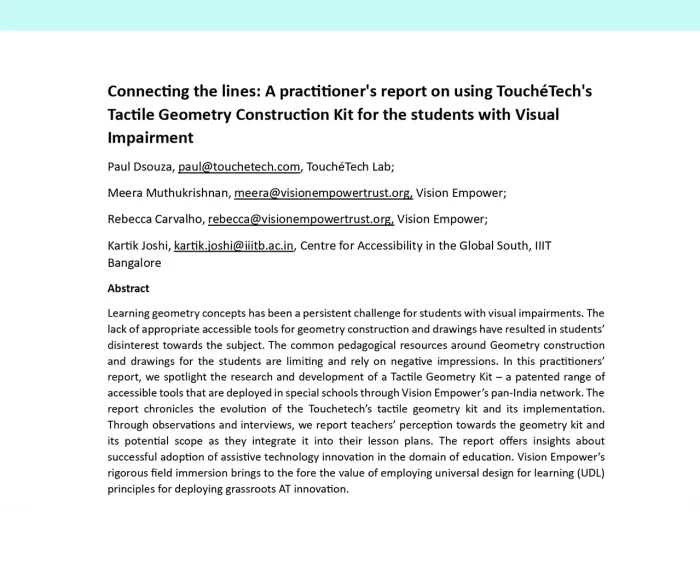
Connecting the lines: A practitioner’s report on using TouchéTech’sTactile Geometry Construction Kit for the students with VisualImpairment

Authors: Paul Dsouza, TouchéTech Lab; Meera Muthukrishnan, Vision Empower; Rebecca Carvalho, Vision Empower; Kartik Joshi, Centre for Accessibility in the Global South, IIIT Bangalore

Abstract

Learning geometry concepts has been a persistent challenge for students with visual impairments. The
lack of appropriate accessible tools for geometry construction and drawings have resulted in students’
disinterest towards the subject. The common pedagogical resources around Geometry construction
and drawings for the students are limiting and rely on negative impressions. In this practitioners’
report, we spotlight the research and development of a Tactile Geometry Kit – a patented range of
accessible tools that are deployed in special schools through Vision Empower’s pan-India network. The
report chronicles the evolution of the Touchetech’s tactile geometry kit and its implementation.
Through observations and interviews, we report teachers’ perception towards the geometry kit and
its potential scope as they integrate it into their lesson plans. The report offers insights about
successful adoption of assistive technology innovation in the domain of education. Vision Empower’s
rigorous field immersion brings to the fore the value of employing universal design for learning (UDL)
principles for deploying grassroots AT innovation.

Click to download the publication

Image showing the first Title and abstract of the paper "Connecting the lines: A practitioner's report on using TouchéTech'sTactile Geometry Construction Kit for the students with Visual Impairment". Click to download the PDF

Well-being at Vision Empower. Article in WIPRO Newsletter Samuhik Pahal January 2025

Meghna Chowdhury and Supriya Dey write on the theme of Well-being at Vision Empower in the January 2025 issue of Samuhik Pahal, WIPRO’s journal of collective action. At Vision Empower (VE), fostering both individual and collective well-being is at the heart of our organizational approach.

Celebrating National Science Day 2024

Vision Empower celebrated National Science Day 2024, from 21st to 28th March 2024 at 34 special schools across 10 states in India. The week-long celebration was a great success. This book captures the essence of Science Day showcasing the incredible achievements of our little Einsteins who created tactile and accessible science models, brought out their inner masterchefs in the no-fire science cookouts and participated with high spirits in the quiz competitions. The book is filled with pictures, highlights, and testimonials from the children, parents, and teachers who participated in the event. 

Vision Empower’s work featured in Wipro Foundation’s Monthly Newsletter- Samuhik Pahal

Head over to page Pg 40 to read Vision Empower’s work on ‘Happily Bridging the Computational Thinking Divide’

Accessible Math Resources for Schools from Vision Empower. Article in Samuhik Pahal, a Wipro Foundation newsletter.

Article by Vaishnavi, Jyoti, Devi and Supriya for Samuhik Pahal, a Wipro Foundation newsletter. The article talks about the various ways Vision Empower is making numeracy accessible for children with visual impairment. (Pg 11)

Overcoming wicked problems and institutional voids for social innovation: University-NGO partnerships in the Global South

Overcoming wicked problems and institutional voids for social innovation: University-NGO partnerships in the Global South. Technological Forecasting and Social Change,Volume 173, 2021,121104, ISSN 0040-1625.

Abstract: This paper argues that, while universities have a crucial role to play in social innovation by democratizing knowledge, fulfilling that role in the Global South requires them to partner with civil society actors such as NGOs. With their history of working with the socially disadvantaged, NGOs have a unique role in clarifying the nature of demand since social innovation must often address ill-formulated “wicked problems”. Similarly, NGOs can fill the “institutional voids” which limit socioeconomic transactions in the Global South. The paper discusses the wicked nature of visual-impairment, which is both widely prevalent and has biopsychosocial attributes i.e., the functional limitations are reinforced by the psychological perceptions of the blind and visually impaired (BVI), and the sociological stigma of impairment. The empirical setting is India where policies for the BVI population are being formulated within a broader framework of social inclusion. The paper investigates how the International Institute of Information Technology Bangalore (IIITB) has taken advantage of state policies to embrace an academic mandate which includes social innovation. Specifically, it explores IIITB’s incubation of the NGO Vision Empower, and the partnership that has followed, to overcome the neglect of the BVI in science and mathematics education.

Design of Programs for Students and Teachers with Visual Impairment in the Global South: A collaborative response to the COVID19 pandemic in Karnataka, India

The following entry from Vision Empower was accepted for the CHI 2021 conference workshop on Disability design in low resource settings.

Design of Programs for Students and Teachers with Visual Impairment in the Global South: A collaborative response to the COVID19 pandemic in Karnataka, India

Supriya presented at the workshop on 16th May 2021.

Introductory video for the workshop:

Accessible Computer Science Fall Workshop : White paper

Supriya from Vision Empower took part in the “Accessible Computer Science Fall Workshop” Nov 17, 2020 – Nov 19 2020 on “Using research to make Computer Science education accessible to all learners” organized by Microsoft, University of Washington, and University of Colorado, Boulder. The whitepaper, Reimagining Accessibility and Inclusion in K12 Computer Science Education Through Curriculum and Professional Development was an outcome of this workshop.

Assistive Technology Research and Disability Studies in the Global South: the Need for Synergy

Co-authored by Vidhya Y for a workshop at The ACM CHI Conference on Human Factors in Computing Systems 2020
View Publication

ICTD2020: Conceptual Learning through Accessible Play: Project Torino and Computational Thinking for Blind Children in India

Gesu India, Geetha Ramakrishna, Joyojeet Pal, Manohar Swaminathan
ICTD 2020 | June 2020

View the Publication at Microsoft Research site

Project Torino is a physical programming environment designed for teaching computational thinking to children in schools in the UK, regardless of the level of vision. We introduced project Torino to children in three schools for the blind in Bangalore, India as a toy for playing with songs, rhymes, and stories. We present the results of 103 semi-structured play sessions spread over three months with 12 children (2 girls, 10 boys) with diverse backgrounds. We found that children progressed from playing with pre-connected examples, to making changes, to actively participating in what items are played. Engaging the children in conversation while they played, we established that the teams had grasped three basic concepts of computational thinking–flow of control, variables, and loops without any explicit instructions towards learning them. We propose that play-based approaches can be successfully used with low resource overhead to introduce fundamental concepts of computational thinking.